The wish:
Rowing on Frankfurt's little river
The wish:
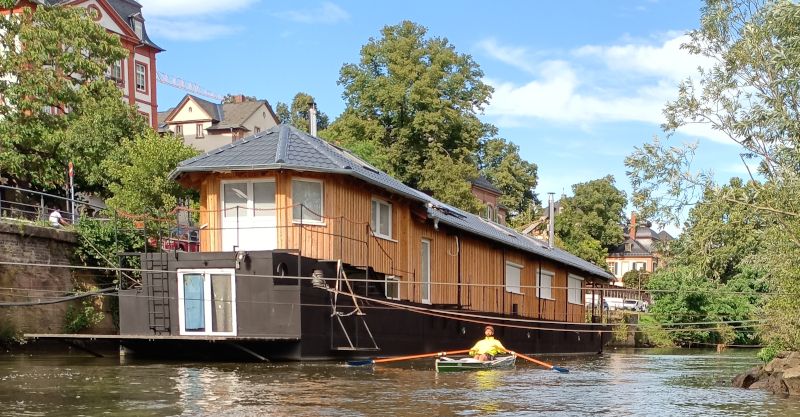
Rowers who know the area will ask themselves how one comes to want to row on the Nidda. The answer lies on the cycle path along the Nidda. Like many other people, the last one and a half pandemic years drove me (even) more outdoors, and routes otherwise covered by underground were now cycled. Trips from the Schwanheim Dune to the Westend, from the Riedberg to Ginnheim, from Eckenheim to Bonames, or along the green-belt cycle path, kept leading along the Frankfurt Nidda. The smooth and deserted water of the canalised river course kept awakening the spontaneous wish „one ought to row here“. And after one and a half years of cycling along the Frankfurt Nidda, there came the one ride that made the cup run over: „I have to row on the Nidda!“
From wish to idea:
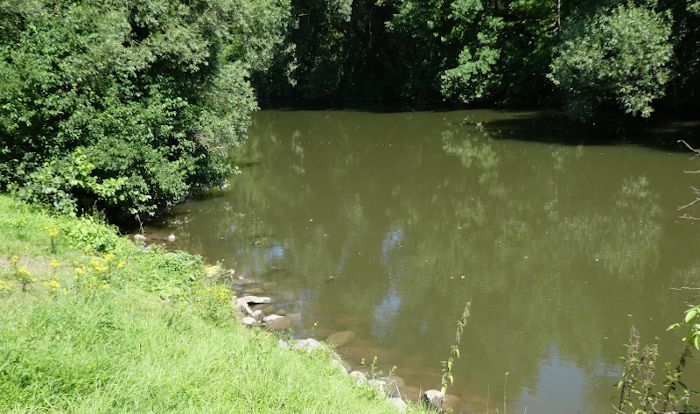
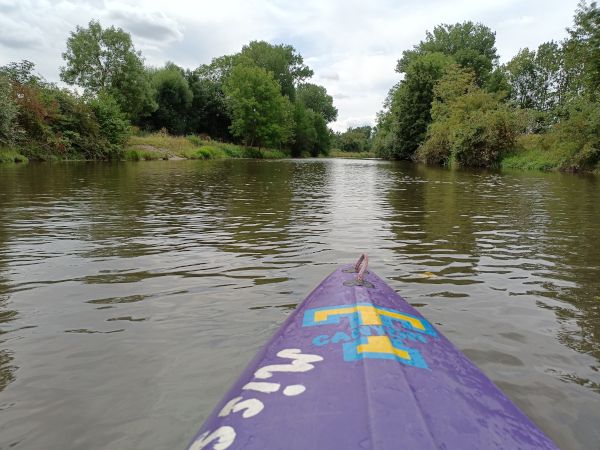
To be able to row on the Nidda, the boat has to be brought to the desired launch point. That makes sense. But there are no really comfortable launch points for rowing boats. Apart from a few narrow staircases leading down to the stony riverbank, the only things that struck me on the cycle rides as theoretically possible launch points were the numerous weirs that line up in Frankfurt's urban area at intervals of about two kilometres but, for rowers, can at best be described as adventurous. So nothing works without help. At the next opportunity, Alex was asked whether he could drive a boat to the Nidda for me and, if necessary, accompany me in the canoe to help me with putting in and out: „Yes, sure, I'll do it.“ Sandra and Katja chimed in: „We'll come along! But then we also want to go where it's scenically beautiful and not just on a canalised river through built-up urban area.“ And so the wish to row a stretch on the Nidda once became the idea of a longer rowing and canoe tour on the Nidda – and if so, then of course everything that can responsibly be rowed gets done.
From idea to plan:
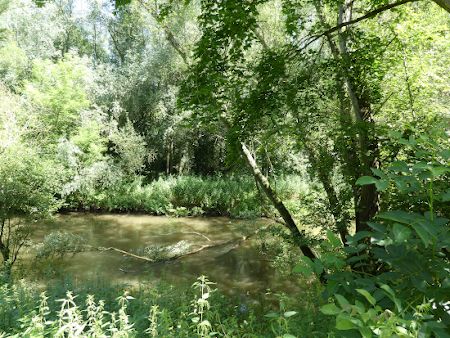
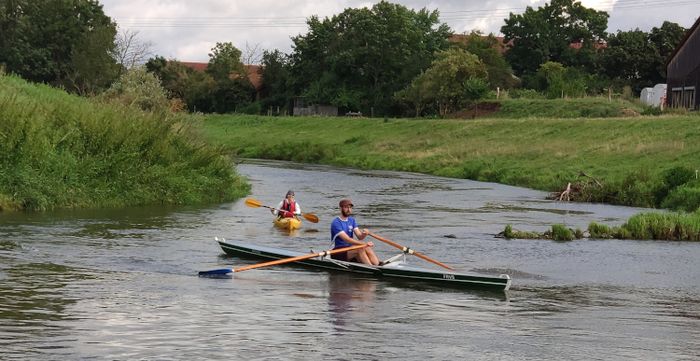
From various tales by canoeists it was known that the Nidda is no longer navigable on certain sections due to renaturation. Exactly where that is could only be found out laboriously on the internet. Various sections and river kilometres were named there. Without a precise route description of the Nidda, however, the closed sections could only be roughly estimated. The first step towards planning was therefore to create a route description. Using the Google satellite image, all bridges, weirs and obstacles visible there were documented together with the respective river kilometre. On the basis of the satellite image alone, of course, no precise route description can be created. So, on a sweltering hot Sunday after the morning row, the Nidda was cycled from the mouth to Dortelweil. The most exciting task then turned out to be finding a suitable launch point in Bad Vilbel or above, but still before the closed sections. In fact, I was able to identify a suitable launch point at the sports ground in Dortelweil. Just below the renaturated sections above Dortelweil. The starting point was thus found. The desired destination, the mouth of the Nidda, was set anyway. The team of two canoes and two bicycles as companions, pilots and carrying helpers was also fixed, so all that remained was to set off rowing and see how far we'd get.
Carrying out the plan:
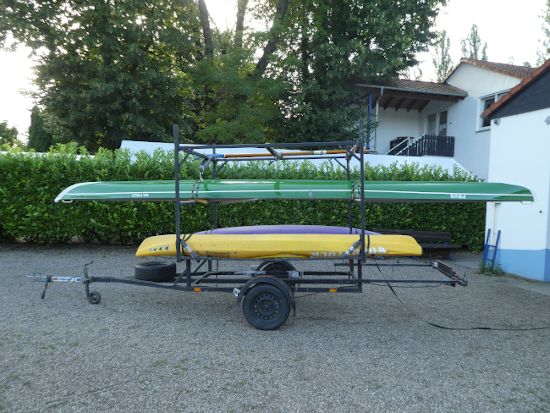
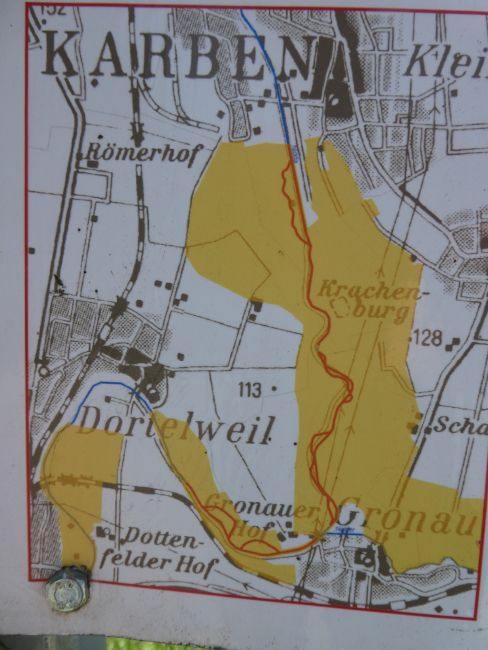
On Saturday after rowing training, two canoes and the „Mafisch“ are loaded onto the canoe trailer. Sunday morning at 8:00 it's off towards Dortelweil. Land-service bicycle no. 1 is in the boot. With this bicycle Alex then rides up the Nidda after moving the bus, until he rejoins the water crew. Udo rides land-service bicycle no. 2 directly to Dortelweil. If you're already rowing the 24.5 Nidda kilometres from Dortelweil to the mouth, you should also make up the full 30 km so that the navigation of the Nidda is registered by the German Rowing Association too. A 24.5-kilometre tour with various portages isn't a touring trip for the DRV. So that this questionable assessment didn't lead to the rowing on the Nidda being swept under the carpet, small laps of 5.5 km were first rowed in and around Dortelweil. Thanks to the rainy weather of the previous days, the Nidda had enough water and we hardly had to deal with shallow spots. However, the current required quite some skill when casting off in Dortelweil, so as not to collide straight away with the bushes and rocks on the other bank of the here very narrow Nidda. The river section around Dortelweil is very idyllic. Kingfishers and dragonflies accompanied the „Mafisch“ on its small laps to the railway bridge. To circle the boat well between the rocks in the narrows with the heightened current, we at first mainly „backed“ downstream, i.e. rowed forwards. After initial scepticism, it was tested that the narrows with heightened current right behind the launch point are passable both downstream and upstream.
After the five and a half kilometres were completed, off we went, accompanied by Sandra and Katja in the two canoes and Udo on the bicycle. The gaze mostly stayed forward. Only before long, easily visible straight stretches did we turn and row „normally“. Just before the Dottenfelder Hof, a swan family blocked the Nidda across its full width. So, in skirting the groynes, we had to adapt to the pace of the swans, who were evidently not used to the presence of boats. The stretch into Bad Vilbel was then less winding and could mostly be managed rowing backwards. The passage through the town of Bad Vilbel then also had some sights to offer: the spa park with the Vilbel castle and a historic wooden bridge – and who can say they've rowed under a library. Out of town, a bridge once again required some skill to get well through the strongly flowing, narrow area between the piers. By now Alex had caught up again on the bicycle and we were approaching the first planned break at the mouth of the Eschbach, before which only one section had to be passed where the branches hanging low over the river required a few lying-down rowing interludes. After a short biscuit break and a land-service change, it then continued towards Eschersheim, where we wanted to hold the scheduled lunch break at the weir.
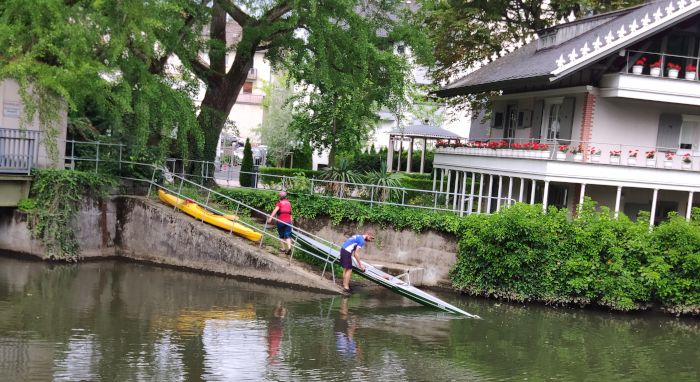
A small rapid, easy to pass, was followed by a section with a densely overgrown bank. The trees seen during preparation, lying across the water, could be circled very well. For this effort the water crew was rewarded with a Frankfurt-jungle feeling: orchids and trees on the bank, many kingfishers flying ahead of the boats, and only the omnipresent plastic rubbish conveys the impression of a big city. When the cycle path on the bank became visible again, however, there was no sign of the land service far and wide. So the critical spot with the many rocks scattered across the river in a rapid had to be passed only with the help of the canoes. Thanks to the favourable water level, Alex could quickly spot a suitable passage between two rocks, easy to hit even with the rowing boat. After a short inspection run into the Kalbach, it was then quickly past the old helicopter landing pad to the Eschersheim weir. In the subsequent break the food tasted excellent and the trip continued on through Frankfurt.
Past the districts of Heddernheim on the right and Eschersheim on the left bank, we reached the Praunheim weir. First lift out the rowing boat, then the two canoes. In the lower water the canoes are then put in first to gain a small lead, which after a few dynamic strokes in the „Mafisch“ is quickly made up again. So much for the routine of portaging. Unfortunately, getting back into the rowing boat here was only possible very awkwardly, since the land-side scull had to be extended and Sandra could barely hold the boat steady. A swimming entry was already being considered when it somehow worked out with a very, very big step. After leaving the district of Praunheim on the right bank behind, we reached the Hausen weir, right by the A66.
The further, very idyllic course of the route leads through the Brentanopark. Some were already reminded of little Venice here. After circling the island we reached the Rödelheim weir. Here the land service could only watch from the other bank as the boats were carried around the Petrihaus. After this was successfully completed and the gates of the barrier fence properly closed again, the sky darkened as we continued.
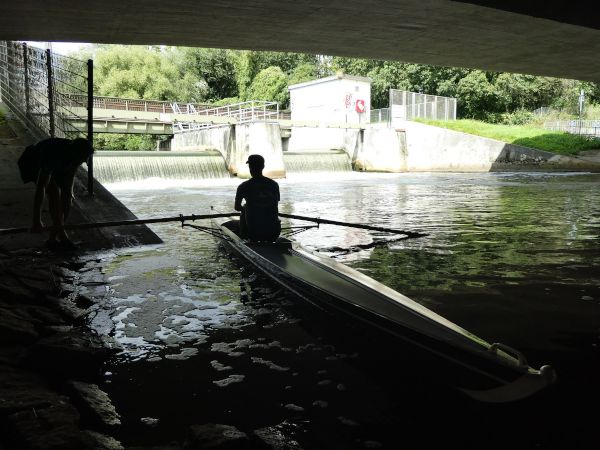
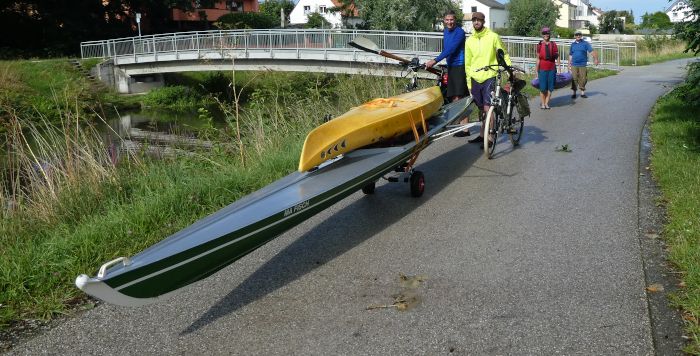
A first heavy rain shower we could sit out under the motorway bridges of the Frankfurt Westkreuz. The second, however, caught us during the portage at the Sossenheim weir. Since it was accompanied by thunder and lightning, a short forced break had to be taken here. After about half an hour and a study of the rain radar, we continued the trip, separated from the mouth into the Main by only one more weir and barely 3 kilometres. To arrive before the next rain, there was only time for a quick photo at the wild water-ski course before, above the renaturated Höchst weir, the boats were taken out of the water again at a bridge. To manage the roughly 400 m to the launch point below the weir, the boat trolley carried on the bicycle now came into use. The caravan of two bicycles, a pair of sculls, a carried canoe and a boat trolley with rowing boat and canoe then moved along the Nidda cycle path.
Below the Höchst weir there were then a few more shallow spots to watch out for. Not all the gates of the canoe slalom course, which lies just before the mouth, could be hit, but the poles are light and a collision isn't painful. After the steel cables in the mouth area were passed lying down and a current-induced collision with the ships moored there avoided, the last metres on the Main to the jetty of the RG Nied could also be managed quickly. Loading the boats, the journey home, and with a good dinner our Nidda adventure then came to an end.
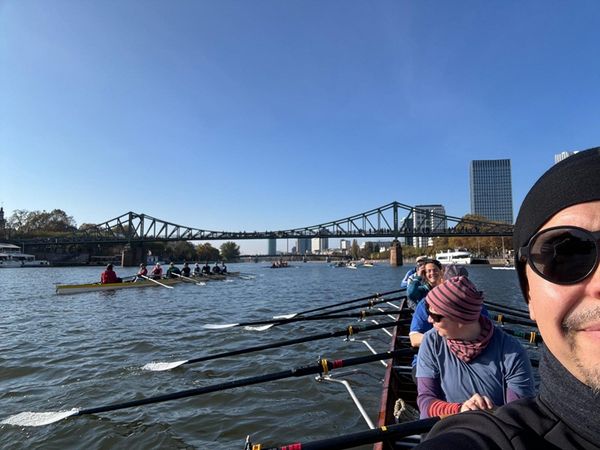
WW8 2024 and 2025
Punctually at 10 a.m., 9 fearless rowers got ready to cast off in our admittedly ageing eight. On the Main, several eights and various other boats were already gathering…
Read more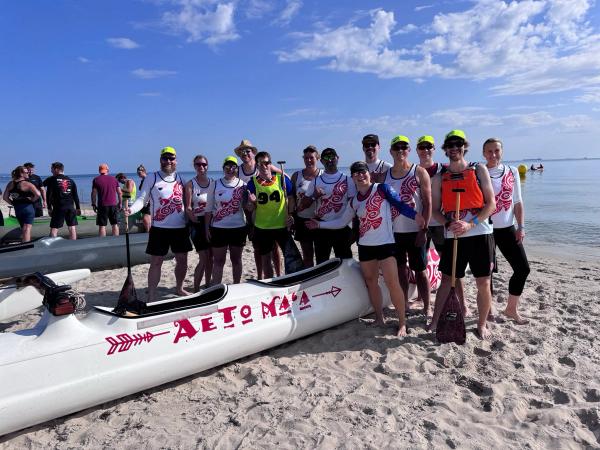
Forever second – and yet content?
The Rugia Hoe 2025 was a very special experience for us as a racing partnership with our outrigger friends from the FKV, the Frankfurter Kanu Verein 1913 e. V. –…
Read more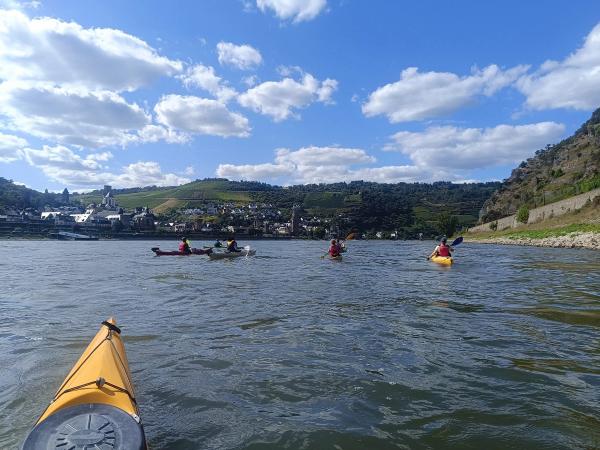
40 km of relaxation in the Middle Rhine valley
On 25 August, some canoeists from the adult canoe group paddled the picturesque stretch between Geisenheim and the Loreley near St. Goarshausen. The…
Read more