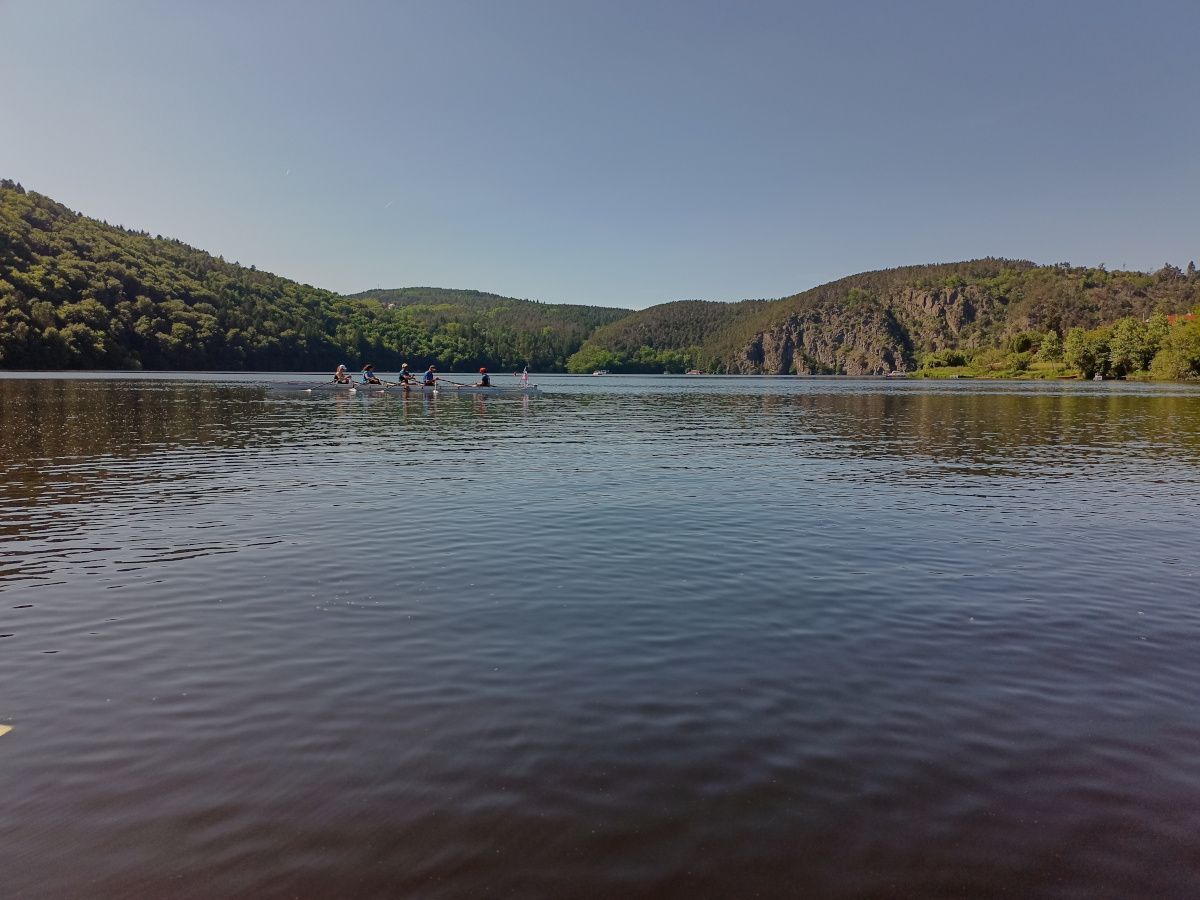
125 years of the Frankfurter Ruder- und Kanusportverein Sachsenhausen 1898! We wanted to celebrate that with a special touring trip. After an announcement, a preliminary meeting, a shortlist…
125 years of the Frankfurter Ruder- und Kanusportverein Sachsenhausen 1898! We wanted to celebrate that with a special touring trip. After an announcement, a preliminary meeting, a shortlist and a vote among those interested, the choice fell on the Vltava. This choice promised not only beautiful scenery – mentally underscored at all times by Smetana's incomparable musical monument – but also a certain adventurous character. We weren't disappointed! The chosen rowing route ran from Budweis (České Budějovice) to Prague, thus connecting two larger Czech cities, and allowed us to travel by road with just one car and boat trailer, while moving the rest of the rowing group onto the rails for a relaxed journey. Overall, the trip on the Vltava was marked by a deep calm, and „dreamlike“ was the usual adjective used to describe the tour afterwards; with mostly little current, the stretch between Budweis and just before Prague is, despite the regular weirs, still wild and one might almost say „natural“.
The biggest difficulty in preparing the tour was making contact with the Czechs, who often spoke no English and, with luck, a little German. Calls usually went unanswered, and even emails translated into Czech were answered almost only by hotels and campsites.
On arrival at the adaptive rowing club in Budweis, with whom no contact could be established beforehand, we were received very warmly after initial scepticism and were allowed to store our two boats there overnight and to launch from the jetty, which was otherwise sealed off with barbed wire. We encountered this warmth and helpfulness of the people throughout our trip in the Czech provinces. In Budweis, the tranquil metropolis of southern Bohemia, you can reach all the sights in the city centre on foot, eat good Bohemian food and taste the local beers. In Budweis the Vltava is, in view of its numerous later reservoirs, relatively narrow and has a noticeable current, so that at the start of the trip we felt reminded of Smetana's composition.
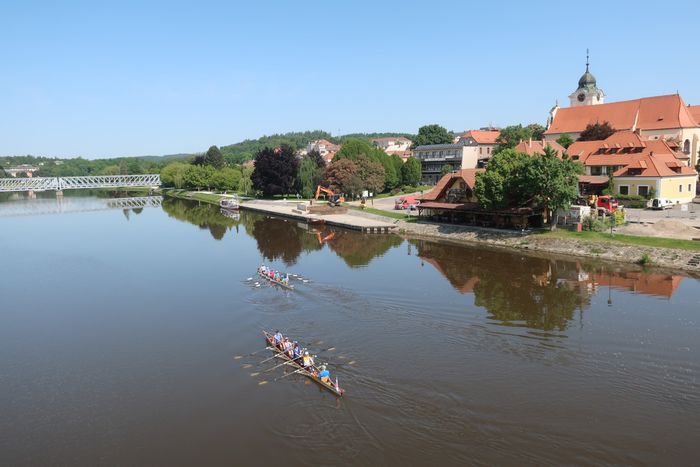
In the best weather, the first day's stage took us past four ideally built locks, climbing rocks, the beautiful Hluboká Castle and lots of forest to Týn nad Vltavou. The canoe club there gave us the last jetty suitable for rowers before the Prague city area. Apart from the pretty church, Týn didn't have much in the way of sights. The small guesthouse on the church square was simple but clean, while the nearby hotel was rather a shady dive. As at most stops, both places insisted on cash payment, so it was essential to stock up on enough cash.
The second day's stage led from Týn to Podolsko. The landscape on this section is shaped by forest and dachas hidden among the trees. We rarely met people on or by the river. Towards the end of the day's stage, the Vltava widened more and more, and it became clearly noticeable that we were already in the backwater of the mighty Orlík dam, which we wanted to reach at the end of the next day's stage. Below the imposing Podolsko road bridge we landed on the sandy beach and camped on a meadow. The planned accommodation in bungalows had been cancelled shortly before the trip due to lease disputes. The committed operator then arranged the camping option and sanitary facilities for us. He's currently rebuilding his burger bar and accommodation, so for future Vltava trips there should be better infrastructure there.
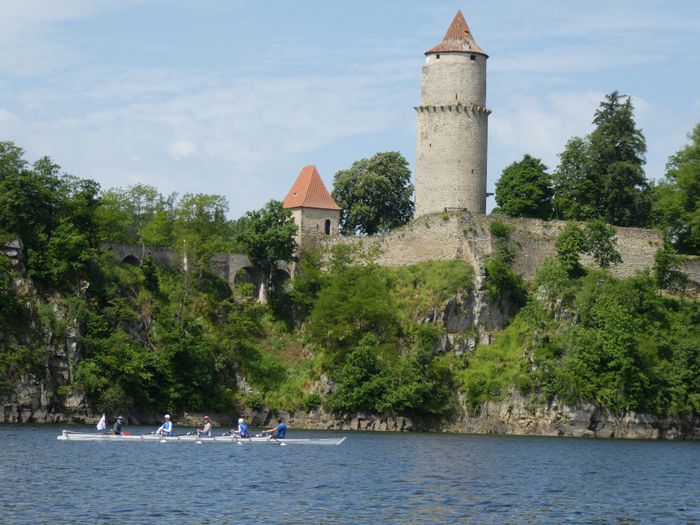
The route of the third rowing day took us to the impressive Orlík dam. On the first 25 km of this stretch, the Vltava offers a lake landscape that thrilled even passionate Canada holidaymakers. In addition, two impressive sights could be admired from the water: the medieval Zvíkov Castle at the confluence of the Otava and the privately owned Orlík Castle. In the afternoon we rowed with a brisk stroke and a headwind to the dam wall, in the hope of still being able to use the boat lift before closing time. On site we were told that Tuesday is a rest day and that our boats could cross the dam wall by lift from 8 a.m. the next day. The rest day is mentioned neither in the lock information on lavdis.cz nor is the online reservation system, which the staff finally pointed out to us on Wednesday morning. At least the information about the registration system could be found afterwards on lavdis.cz in a pop-up window on the overview map of the Vltava updated at the end of May. As a precaution, we had in any case chosen the campsite right in front of the dam wall as accommodation. The site was beautifully situated with a fantastic bathing bay on the Vltava; only the bungalows are not recommended. For lack of open restaurants, we drove to nearby Bohostice for dinner, where we were excellently looked after in a small, local slow-food restaurant.
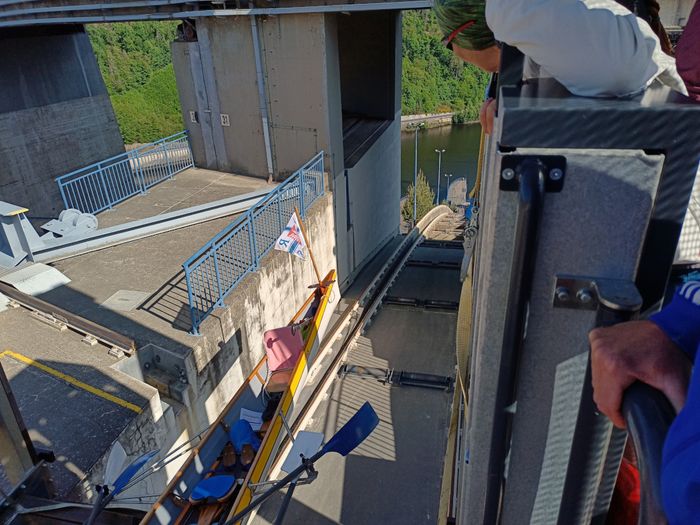
The fourth rowing day began with the impressive ride on the boat lift. The very friendly staff dropped everything in the control centre to be able to get us over the dam despite the missing online reservation. Boats up to ten metres long can be transported on the lift. About three metres of the stern hangs free, so that during the lift's rotation at the top of the dam, a construction fence had to be pushed away by a few centimetres so that everything would fit. After this exciting ride, the Vltava led us through the scenically beautiful river loop near Solenice; sadly we didn't manage a shore excursion to the observation tower. The rest of the rowing day passed uneventfully, and it was noticeable that we were slowly approaching Prague, as more and more houseboats lay along the picturesque bank. Our destination for the day was Cholín, where we spent the night in a very pleasant guesthouse and had a barbecue.
On the fifth and penultimate rowing day, we rowed from Cholín to Davle, a small town outside Prague. The first 25 rowing kilometres took us across the reservoir to the Slapy dam wall. The landscape became increasingly rugged, with mostly steeply falling rock faces and numerous dachas, some adventurously built into the slopes. We transported our boats around the dam wall with our boat trailer, since the tractor intended for this doesn't run on Thursdays. Between the dam wall and the next lock lies a very idyllic stretch of river, with nothing but forest, rocks and self-built moorings on the bank. From the Štěchovice lock, sports boats are only locked downstream on the odd hour. The lock keeper therefore made us wait twenty minutes in the lock chamber until she started the lockage punctually at 5 p.m. Immediately after the lock the landscape suddenly changed. On the bank there were now small villages with roads on which a caravan of cars rolls to Prague in the morning and back again in the evening. After the confluence of the Sázava we reached Davle, where we took our boats out very awkwardly on a ramp. At the Hotel Zur alten Brauerei they tried to rip us off by demanding double the price, and in cash on the spot. After a short discussion we paid only the actual price, but then preferred to dine elsewhere. The pizzeria was very good and also offers rooms for smaller groups.
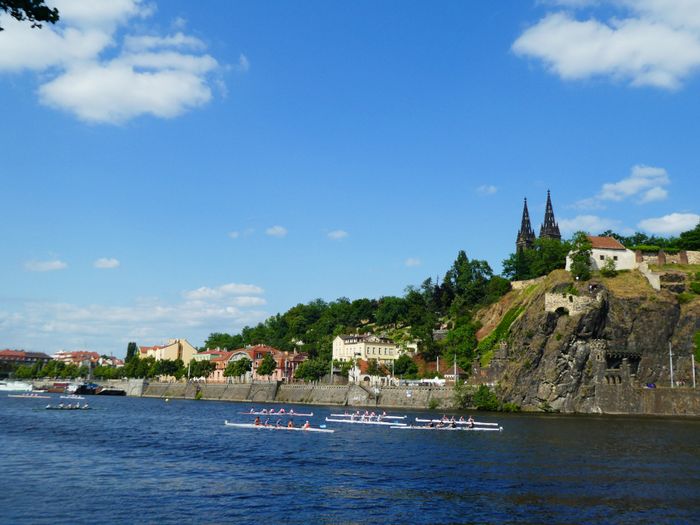
The last rowing day to Prague had little more to offer scenically. At both locks we were locked through without waiting, so that we were quickly in Prague and ended our touring trip at the campsite with a view of the Vyšehrad fortress. Thus our touring trip began and ended like Smetana's composition.
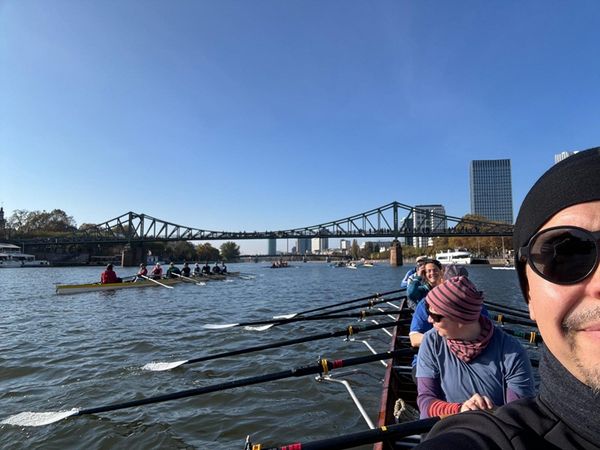
WW8 2024 and 2025
Punctually at 10 a.m., 9 fearless rowers got ready to cast off in our admittedly ageing eight. On the Main, several eights and various other boats were already gathering…
Read more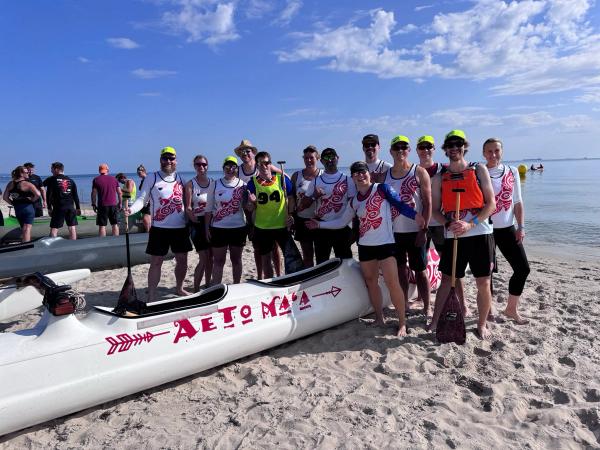
Forever second – and yet content?
The Rugia Hoe 2025 was a very special experience for us as a racing partnership with our outrigger friends from the FKV, the Frankfurter Kanu Verein 1913 e. V. –…
Read more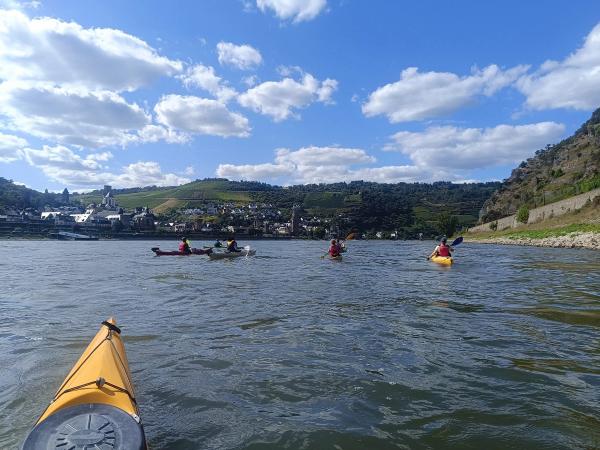
40 km of relaxation in the Middle Rhine valley
On 25 August, some canoeists from the adult canoe group paddled the picturesque stretch between Geisenheim and the Loreley near St. Goarshausen. The…
Read more